
Rebuilding the Book: Starting Fiddler on the Roof

Bohème closed, and the next project has already arrived: Fiddler on the Roof at Opera San Jose.
I was the assistant director on this production of Fiddler back in the summer of 2025 at Cincinnati Opera, where Crystal Manich built an outstanding staging that has since taken on a life of its own. It went to Austin Opera last season, a remount I wasn’t able to be part of, and now I get to pick it back up for Opera San Jose, with Detroit Opera still to come next year. There’s something particular about a production that travels. It isn’t a museum piece being carefully preserved under glass. It’s alive, and every time it lands in a new house it breathes a little differently, which means my job is really about catching up with a show that’s kept moving without me.
So the next two weeks are mostly me and the score, reacquainting myself with a world I haven’t lived in for over a year. It’s a strange kind of memory, the muscle memory of a production. I open the score expecting to have to relearn everything, and instead it comes back almost immediately, like I saw the show last month instead of last year. Entrances, exits, who’s carrying what, who exits with the milk cans and who exits without them. It’s all still in there somewhere.
One decision I made early was to rebuild my blocking book from scratch rather than working off my old one. Partly that’s just discipline. A fresh book forces me to actually look at every scene again instead of coasting on what I remember, which is its own kind of danger with a show you’ve done before. But mostly it’s because Austin wasn’t a carbon copy of Cincinnati. Crystal and the team made real changes there; the show shifted the way productions do when they meet a new space and a new cast, and I don’t want to be carrying blocking in my head that’s already a year and a city out of date. Better to start clean and let the current production tell me what it actually is.
My new book already looks like chaos to anyone but me. I color-code everything with Post-its: green for entrances, because green means go, blue for exits, pink for props, purple for costumes, orange for deck and rail cues, and a lighter pink for transitions. Open it up and it looks like a stationery store exploded. But it’s a system I trust, and by the time we’re in the room it’ll be the thing that lets me answer any question about the show in about four seconds flat.
The rest of my week has had nothing to do with opera at all, which has been its own kind of good. I’m in Corpus Christi right now with my fiancée, who is president of Pride Corpus Christi, and this weekend is their parade and block party, the biggest event of their year. I’m stage managing the mainstage show for the block party, more than forty performers across the parade and the afternoon and evening that follow. It’s a lot of moving parts, just like tech week, just a completely different world of moving parts. I like having something on my plate that isn’t opera. It’s a good reminder that the same instincts, keeping track of who goes where and when, apply just about anywhere people are trying to put on a show.
Back to the score this week, and back to Anatevka. More soon. You can learn more about Fiddler on the Roof in San Jose here!
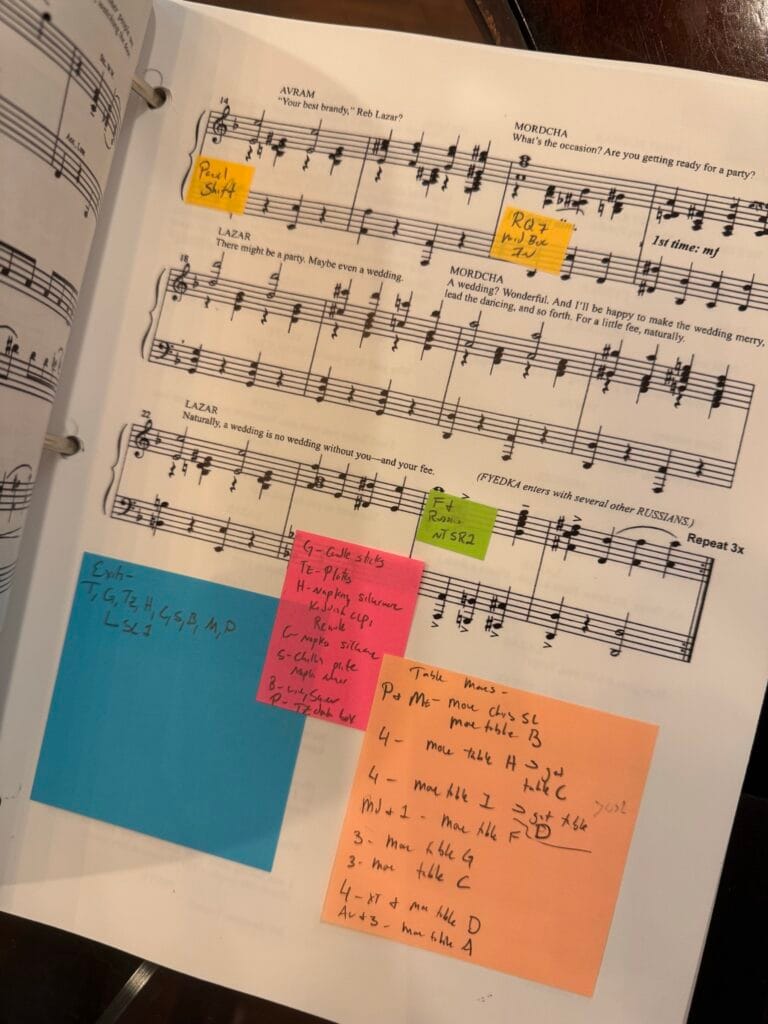
A page of Music from Fiddler with some staging information. I still have to add my "Minis" or the pages with the actual blocking written down, but getting in this information is my first step.